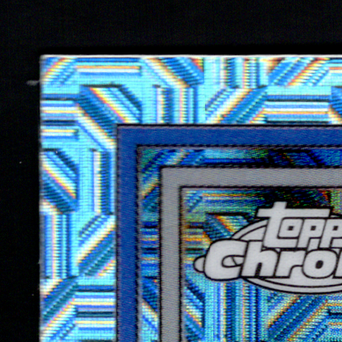
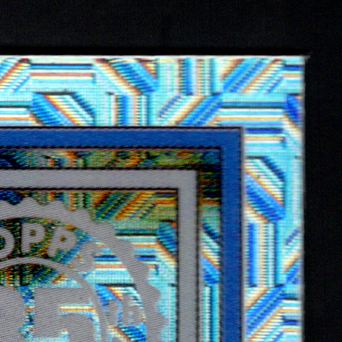
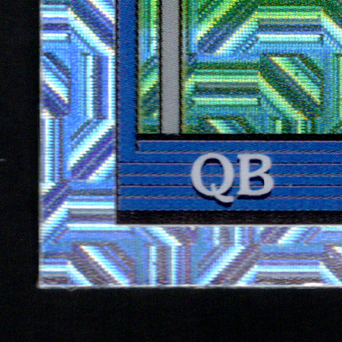
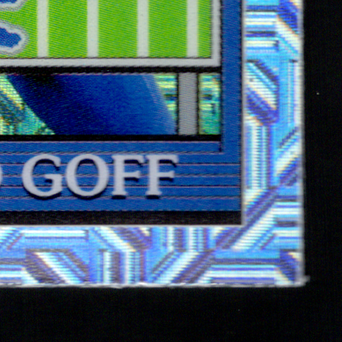
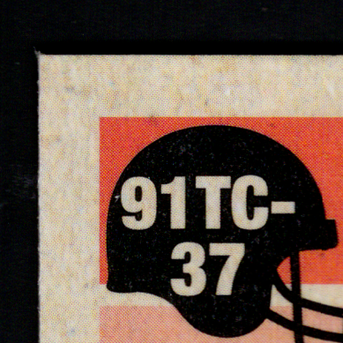
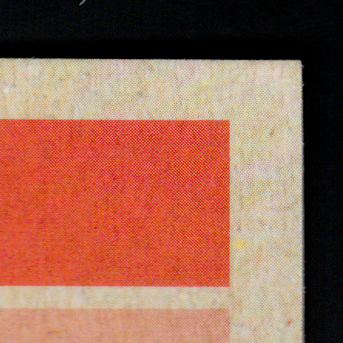
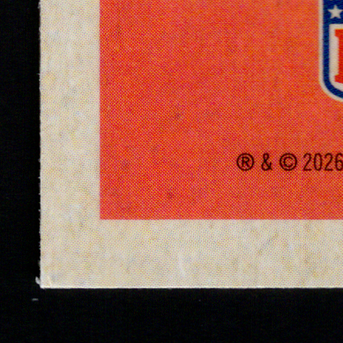
Every corner is graded three ways at once — a vision model reads the photo, a trained classifier and reference library compare it against thousands of graded corners, and where the boundary is clean enough, the corner is physically measured from its silhouette. Everything below speaks one language:
- Corner annotation:
- Each corner's word is its annotation class, assigned directly from the decimal: Pristine 9.9+ · Sharp 9.75–9.8 · Very slight touch 9.4–9.7 · Slight rounding 9.05–9.3 · Minor rounding 8.2–9.0 · Moderate flattening 7.0–8.1 · Heavy rounding below 7. Same vocabulary used to annotate and train the corner models. Whitening and fray are separate observations from the color photo. The weakest corner anchors the corners subgrade.
- Tip angle:
- The angle where the two cut edges meet, found by fitting a straight line along each edge. A factory-square corner measures 87–93°. It is a squareness test, not a ranking — everyday wear happens at the very tip and leaves the edges untouched, so a worn corner can still measure ~90°. Only a skewed or crushed corner fails this test.
- Deficit:
- The percentage of material missing from the tip wedge — the gap between where a perfect tip would be and where this card's material actually ends. Under 2% means the tip is fully present.
- Roughness:
- How much the cut edge waves compared to a perfectly straight line, in pixels. A clean factory cut measures under about 2px.
- Whitening & fray:
- Surface wear read from the color photo — geometry cannot see it. Severities are the grading rubric's own words: trace, minor, obvious, heavy for whitening; light, evident, exposed for fray. This is how a geometrically square corner can still lose points: to whitening, not shape.
- Visual proof:
- Red and blue lines are the fitted cut edges; the yellow ring marks where a perfect tip would be; the green ring marks where material actually ends. Rings stacked on top of each other mean a square corner.
- When numbers are absent:
- If printed design runs along the boundary, the instrument cannot measure reliably. Those corners show the photo only, and the grade rests on the full model consensus. Factory-rounded cards (Pokémon and other TCGs) are die-cut with a corner radius, so square-tip measurements do not apply — those corners are graded by the model consensus and the rounded-corner reference library.
Read the full methodology: How to Grade Card Corners — the Vision™ white paper →